Natural and Synthetic Graphite: Different Materials for Different Applications
Natural and synthetic graphite are not two interchangeable sources of the same standard product. They follow different production routes, carry different cost structures and impurity profiles, and are suited to different applications.
Graphite is often discussed as a single commodity, but the market actually covers two materials with distinct origins, production routes and performance characteristics: natural graphite, mined and processed from mineral deposits, and synthetic graphite, manufactured from carbon precursors through high-temperature treatment. Both are used in battery anodes, but each also serves applications the other does not reach economically or technically.
Why graphite matters
Graphite’s commercial relevance rests on a specific combination of properties:
- Electrical conductivity
- Thermal resistance
- Chemical stability
- Lubricating properties
- Ability to host lithium ions in battery anodes
No single application requires all of these properties at once, which is one reason the same word, graphite, covers materials with very different specifications.
Where natural graphite comes from
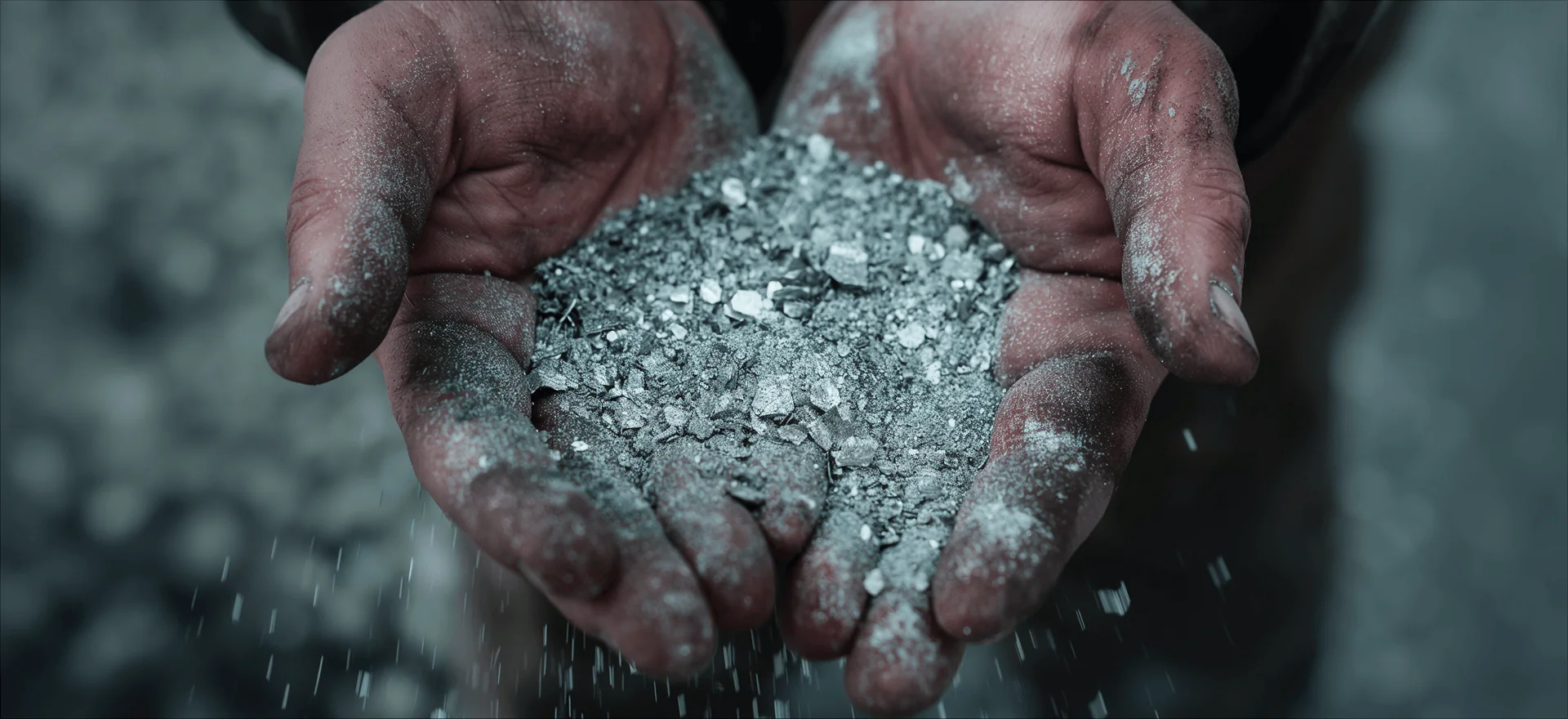
Natural graphite is mined as flake, amorphous or vein graphite, depending on the deposit, and each form carries different crystal structure, particle size and typical carbon content, which in turn shapes which end uses it is suited to without further upgrading. After extraction, the ore is crushed and put through beneficiation, a combination of flotation and physical separation steps that concentrate the graphite content of the run-of-mine ore, which otherwise contains a large proportion of waste rock.
The concentrate is then purified, either chemically or thermally, to remove residual silicates, metal oxides and other minerals that would otherwise limit its performance. For most industrial applications, this level of processing is sufficient. Battery-grade material requires a further, more demanding step: spheroidisation, which rounds the flake particles to improve packing density and electrochemical performance, followed by a carbon coating that protects the particle surface and improves cycling stability in the finished anode. Each of these additional steps adds cost and yield loss, which is part of why battery-grade natural graphite trades at a significant premium over industrial-grade material.
How synthetic graphite is produced
Synthetic graphite starts from a carbonaceous precursor, typically petroleum coke or needle coke, selected according to the target application; needle coke, in particular, is prized for the anode and electrode market because its acicular microstructure graphitizes into a material with low thermal expansion and good electrical conductivity. Specialty petcoke grades are ground and blended with coal-tar or petroleum pitch, which acts as the binder in shaped graphite products such as electrodes; the mixture is formed and baked at moderate temperature to burn off volatiles and set the shape, and is then subjected to high-temperature graphitization, typically above 2,500°C, which converts the amorphous carbon structure into the ordered crystalline structure that gives graphite its properties. The resulting material is machined, ground, classified or coated depending on whether the end use is a battery anode, an electrode or a specialty graphite component, and the graphitization step itself is by far the most energy-intensive part of the process.
Natural graphite versus synthetic graphite
| Parameter | Natural graphite | Synthetic graphite |
| Origin | Mined mineral | Manufactured from carbon precursors |
| Production route | Mining, beneficiation, purification | Calcination, baking and graphitization |
| Consistency | Depends on deposit and processing | Can be engineered more precisely |
| Purity | Requires purification | High purity achievable through processing |
| Particle morphology | Determined by ore and downstream processing | Can be adjusted for target application |
| Energy requirement | Mainly mining and purification | High, due to graphitization |
| Main commercial risks | Ore quality, purification and geographic concentration | Feedstock quality, electricity cost and graphitization capacity |
A few observations follow from the comparison. Synthetic graphite’s advantage is control: because the process starts from a chosen precursor and passes through defined thermal steps, producers can engineer particle morphology and purity within relatively tight tolerances. Natural graphite’s advantage is cost and embodied energy: mining and purification generally consume less energy per tonne than graphitization, provided a suitable deposit is available. Neither advantage is absolute, and the right choice depends on which property the application actually values most.
Key applications
Lithium-ion batteries and battery energy storage systems (BESS). Both natural and synthetic graphite are used as anode active material, often in blended formulations that combine the cost advantage of natural graphite with the cycling stability of synthetic graphite, as set out in our review of carbon’s role in modern batteries.
Electric arc furnace electrodes. This market is predominantly served by synthetic graphite, where the quality of the underlying needle coke and its thermal performance under repeated heating and cooling cycles are decisive for electrode life and consumption rates in the steel mill.
Foundries and recarburizers. Graphitized petroleum coke and other processed carbon materials are used as carbon-raising agents in steel and iron production, where controlled, low-impurity carbon pickup is the main requirement.
Refractories. Natural flake graphite and application-specific synthetic grades are both used in carbon-containing refractory brick and monolithic linings, depending on the thermal and mechanical demands of the vessel they protect.
Lubricants and friction materials. Natural graphite and specialty processed graphite grades are valued for their lamellar structure, which allows layers to slide against one another under load.
Expandable graphite and fire-retardant applications. These generally rely on suitable natural flake grades, whose layered structure allows them to expand rapidly on heating and form an insulating char.
Specialty high-temperature applications. Synthetic graphite components, crucibles, heating elements and furnace parts rely on the material’s combination of thermal stability, machinability and chemical inertness at temperatures where most metals would fail.
Application-specific quality parameters
Material selection should be based on the parameters the application actually requires, including:
- Purity and ash content
- Sulfur and nitrogen
- Trace metals
- Crystallinity
- Particle size distribution and morphology
- Tap density and surface area
- Electrical and thermal conductivity
- Electrochemical performance, for battery grades
None of these parameters is universally important. A refractory buyer cares little about electrochemical performance, and a battery-anode buyer is unlikely to specify tap density in the same terms as a lubricant formulator. Defining the parameters that actually govern performance in the intended application, and requiring them in the purchase specification, is a more reliable starting point than requesting “battery-grade” or “high-purity” graphite without further definition.
European supply-chain context
Natural graphite is on the EU’s list of critical raw materials, reflecting Europe’s limited domestic mining and processing capacity. The International Energy Agency estimates that China accounts for more than 90% of global graphite refining and anode active material production, a concentration that covers both the purification of natural graphite and the graphitization step used for synthetic material. For European buyers, this concentration makes origin, processing location and the resilience of the supply chain relevant procurement questions in their own right, separate from price.
Two developments may gradually broaden the supply base available to European buyers. First, recycling of graphite from spent lithium-ion batteries is attracting investment, since recovered graphite can in principle be reprocessed into anode-grade material at lower energy intensity than primary production. Second, new processing and purification technologies, including some designed to reduce the environmental footprint of purification, are being piloted outside the traditional production centres. Neither is yet a substitute for the existing supply chain at scale, but both are worth tracking by any buyer building a multi-year sourcing strategy.
Procurement conclusion
Material selection should start from the application and the performance it requires, not from the generic product name “graphite”. A battery-grade anode material, a graphite electrode, a graphitized petroleum coke recarburizer and a specialty graphite component are four different products with four different specification sets, even where the underlying element is the same.
Prime Elements’ work in this space is grounded in upstream carbon knowledge: sourcing and qualifying petroleum coke as a precursor for selected synthetic graphite products, understanding sulfur, ash, metals and structural consistency, and applying the same calcination and graphitization know-how that underpins carbon materials for battery supply chains. Prime Elements does not currently supply battery-grade graphite as part of its portfolio; this article is intended as a market and procurement reference rather than a product statement.